
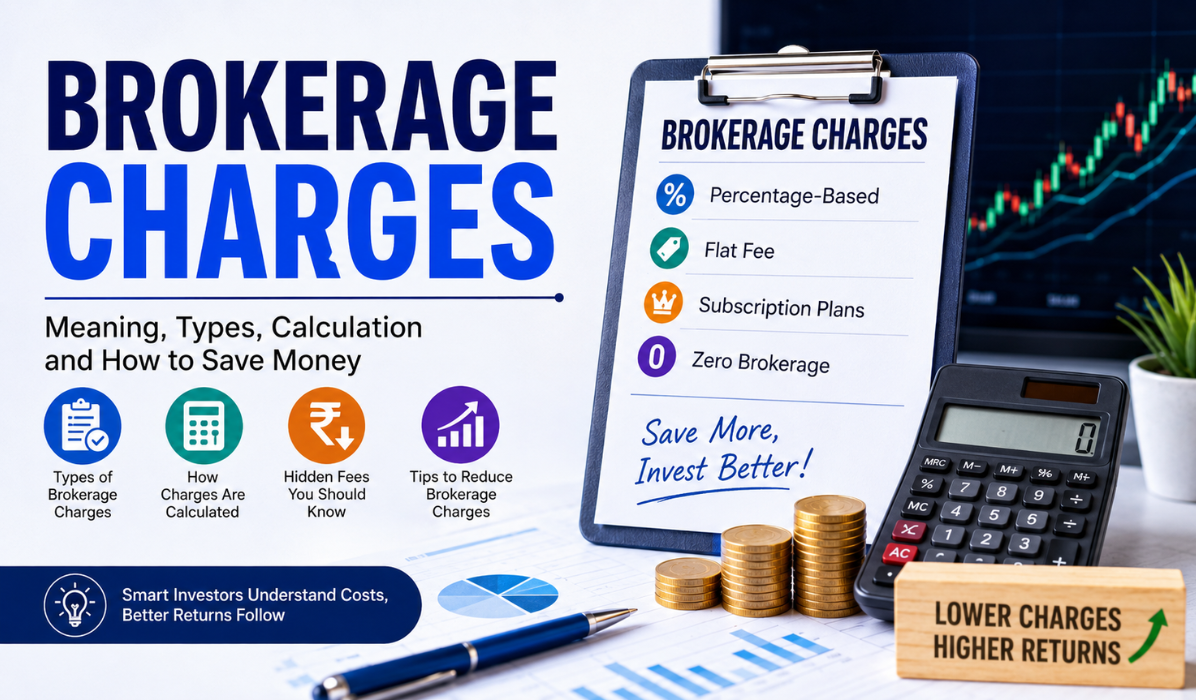
Brokerage Charges Explained: Types, Calculation and Savings Guide
Understanding of brokerage charges is a must if you trade or invest in the stock market. Most novices only pay attention to their profits and forget about trading costs. But small charges can have a massively detrimental effect on your long term returns even through compounding.
Getting a good deal on brokerage charges may also help you select the proper broker, ultimately saving you from incurring pointless expenses whether you are investing in stocks for long term or intraday buying and selling. In this guide, you will understand all there is about brokerage charges; the meaning of it, types, how to calculate brokerage charge, etc., along with some more expenses involved while trading and tips that help save your money from falling into that pit.
What Are Brokerage Charges?
Brokerage charges are levied by a stockbroker and are charged for executing buy/sell orders for investors. When you buy or sell shares, mutual funds, commodities, currencies, derivatives through a broker you pay the brokerage fee for this service.
This collection of charges is one of the primary revenue sources for brokerage firms. The figure may differ depending on:
- Type of broker
- Trading segment
- Trade value
- Brokerage plan
- Frequency of trading
Why Are Brokerage Charges Important?
Many investors underestimate trading costs. While a single trade may involve a small fee, frequent trading can result in substantial expenses over time.
Understanding brokerage charges helps you:
- Calculate actual profits and losses
- Compare brokers effectively
- Select cost-efficient trading plans
- Avoid hidden fees
- Improve long-term investment returns
Experts often recommend checking the complete charge structure rather than focusing only on advertised brokerage rates.
Types of Brokerage Charges
There are several ways brokers charge their customers.
1. Percentage-Based Brokerage
In this model, the broker charges a percentage of the total transaction value.
Example:
- Trade Value: $5,000
- Brokerage Rate: 0.30%
Brokerage = $5,000 × 0.30% = $15
The higher the trade value, the higher the brokerage amount. This model is commonly used by full-service brokers.
2. Flat Fee Brokerage
Many discount brokers charge a fixed fee per order regardless of trade size.
Example:
- Trade Value: $1,000 or $50,000
- Brokerage: Fixed $0.25 per trade (or equivalent local fee structure)
This model is preferred by active traders because costs remain predictable.
3. Monthly Subscription Plans
Some brokers offer unlimited trading plans where traders pay a monthly or annual subscription fee instead of paying per trade.
This option is suitable for:
- High-frequency traders
- Intraday traders
- Professional market participants. Zero Brokerage Plans
Certain brokers offer zero brokerage on delivery-based equity investments while charging fees for intraday or derivative trading.
These plans are attractive for long-term investors who trade less frequently.
Full-Service Broker vs Discount Broker
| Feature | Full-Service Broker | Discount Broker |
| Brokerage Cost | Higher | Lower |
| Research Reports | Yes | Limited |
| Investment Advice | Yes | Usually No |
| Portfolio Management | Available | Limited |
| Trading Platform | Advanced | Basic to Advanced |
| Suitable For | Beginners & Investors | Active Traders |
Full-service brokers provide personalized assistance, while discount brokers focus mainly on low-cost trade execution.
Read More: Popeyes Prices | Raising Cane’s Prices Menu
How Brokerage Charges Are Calculated
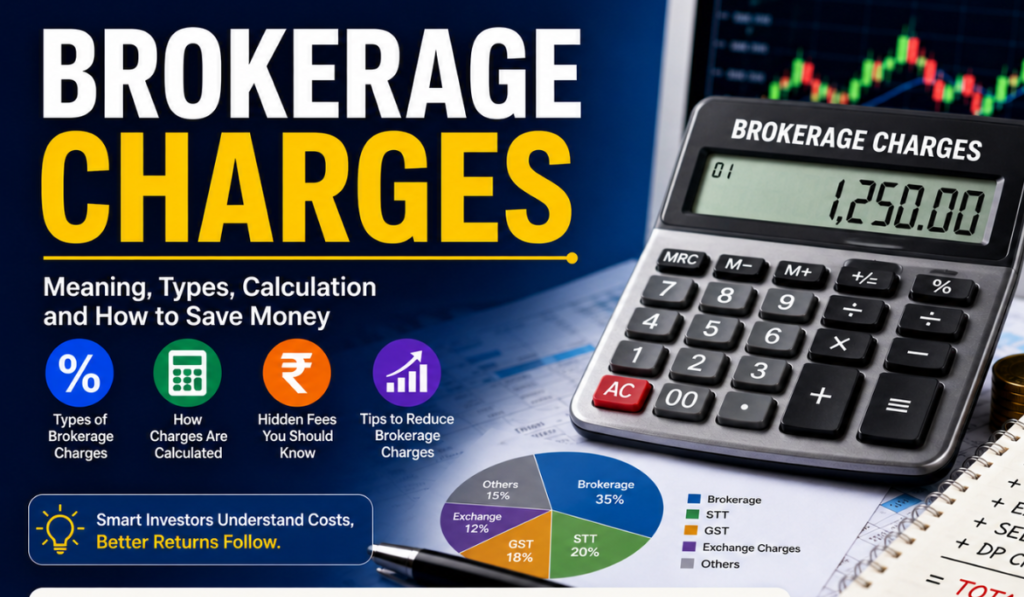
The calculation depends on the broker’s pricing model.
Formula for Percentage Brokerage
Brokerage = Trade Value × Brokerage Rate
Example:
| Details | Value |
| Buy Value | $10,000 |
| Brokerage Rate | 0.20% |
| Brokerage | $20 |
Formula for Flat Brokerage
Brokerage = Fixed Fee Per Order
Example:
| Details | Value |
| Trade Value | $20,000 |
| Flat Brokerage | $5 |
| Total Brokerage | $5 |
Regardless of trade size, the brokerage remains fixed.
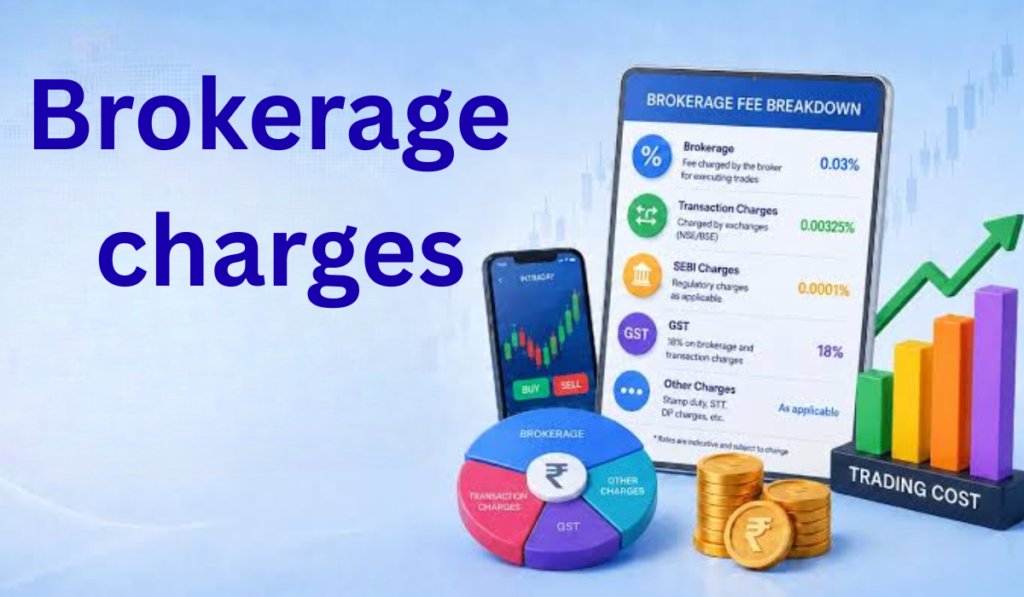
Additional Charges Apart from Brokerage
Many traders think brokerage is the only expense. In reality, several other charges appear on contract notes.
Common Additional Charges
| Charge Type | Purpose |
| STT (Securities Transaction Tax) | Government tax on trades |
| GST | Tax on brokerage and services |
| Exchange Transaction Charges | Exchange operating fees |
| SEBI Charges | Regulatory fees |
| Stamp Duty | State-imposed duty |
| DP Charges | Demat share debit fees |
These costs can sometimes exceed the brokerage itself, especially for active traders.
What Are DP Charges?
DP (Depository Participant) charges are fees collected when shares are sold from a demat account. Many investors overlook DP charges while comparing brokers. Some brokers charge a fixed amount, while others may apply percentage-based fees. These costs can impact your net returns significantly.
Brokerage Charges in Different Trading Segments
Equity Delivery
- Often zero brokerage with discount brokers
- Suitable for long-term investors
Intraday Trading
- Brokerage charged on every trade
- Commonly flat-fee based
Futures Trading
- Fixed fee per executed order
- Lower percentage compared to equity
Options Trading
- Brokerage usually charged on premium value
- Subject to regulatory limits and broker policies
Factors Affecting Brokerage Charges
There are a number of factors that decide your brokerage fee.
1. Trading Frequency
If you are a frequent trader, low-cost brokerage plans have proven useful to you.
2. Trade Volume
Percentage-based brokerage makes it more expensive to deliver larger transaction values.
3. Broker Type
Full-service brokers typically charge higher fees than discount brokers.
4. Market Segment
The brokerage structure might be different for equity, commodity, currency and derivatives.
5. Subscription Plans
This lower pricing is useful for active traders using the monthly plans.
How to Reduce Brokerage Charges
If all the trading costs are reduced then profitability can be increased.
1. Compare Brokers Carefully
Look entirely beyond advertised brokerage and review the full fee structure
2. Use Discount Brokers
Typically, discount brokers offer lower-cost transactions.
3. Choose Suitable Trading Plans
Subscription-based plans might be helpful to high-volume traders.
4. Trade Less Frequently
Do not trade excessively if it is not part of your trading plan.
5. Review Contract Notes
For all the hidden charges, contract notes reveal and pinpoint what is unnecessary spending.
Common Mistakes Investors Make
Many investors unknowingly increase their costs by:
- Ignoring DP charges
- Overtrading
- Not comparing brokers
- Choosing expensive brokerage plans
- Focusing only on brokerage while ignoring taxes and regulatory fees
These mistakes can gradually reduce overall returns.
Brokerage Charges vs Other Trading Costs
| Cost Type | Paid To |
| Brokerage Charges | Broker |
| STT | Government |
| GST | Government |
| Exchange Charges | Stock Exchange |
| SEBI Charges | Regulator |
| Stamp Duty | State Government |
| DP Charges | Depository Participant |
Understanding this difference helps investors evaluate the actual cost of each trade.
Are Brokerage Charges Regulated?
Yes. Securities and Exchange Board of India (SEBI) : Stock brokers need to follow rules founded by SEBI in India. Tariff structures of all components in a stock broker’s pricing machinery are required to be shared with the clients, while prices on brokerage for every trading segment have been capped at various levels.
Read More: Dutch Bros Menu with Prices | Chick-fil-A Breakfast Menu with Prices
Conclusion
Brokerage fees-refers to brokerage charges, are also an integral portion of stock market investing and trading. Although these margins may seem minor, they can put a dent in longer-term returns if you are an active trader. Learning about how brokerage functions, analyzing broker plans, examining its various charges such as GST, STT from prior to Oct 2023 and fees associated with trading exchanges etc.
When you sign up for a trading account always check the total cost structure instead of only getting fixated on the advertised brokerage. Look for a broker with zero or reasonable and clear brokerage charge, you should select a broker that can help you maximize your return from investment and save unnecessary expenses.
FAQs About Brokerage Charges
1. What are brokerage charges in the stock market?
It is fees paid to a broker for executing buy and sell transactions on behalf of investors.
2. How are brokerage charges calculated?
They are calculated either as a percentage of the transaction value or as a fixed fee per trade, depending on the broker’s pricing model.
3. Can brokerage charges affect profits?
Yes. Frequent trading and high brokerage costs can reduce overall investment returns significantly.
4. Are brokerage charges the same for all brokers?
No. Different brokers have different pricing structures, service models, and fee schedules.
5. How can I reduce brokerage charges?
You can reduce brokerage charges by comparing brokers, selecting low-cost plans, avoiding unnecessary trades, and monitoring additional fees such as DP charges and taxes.