
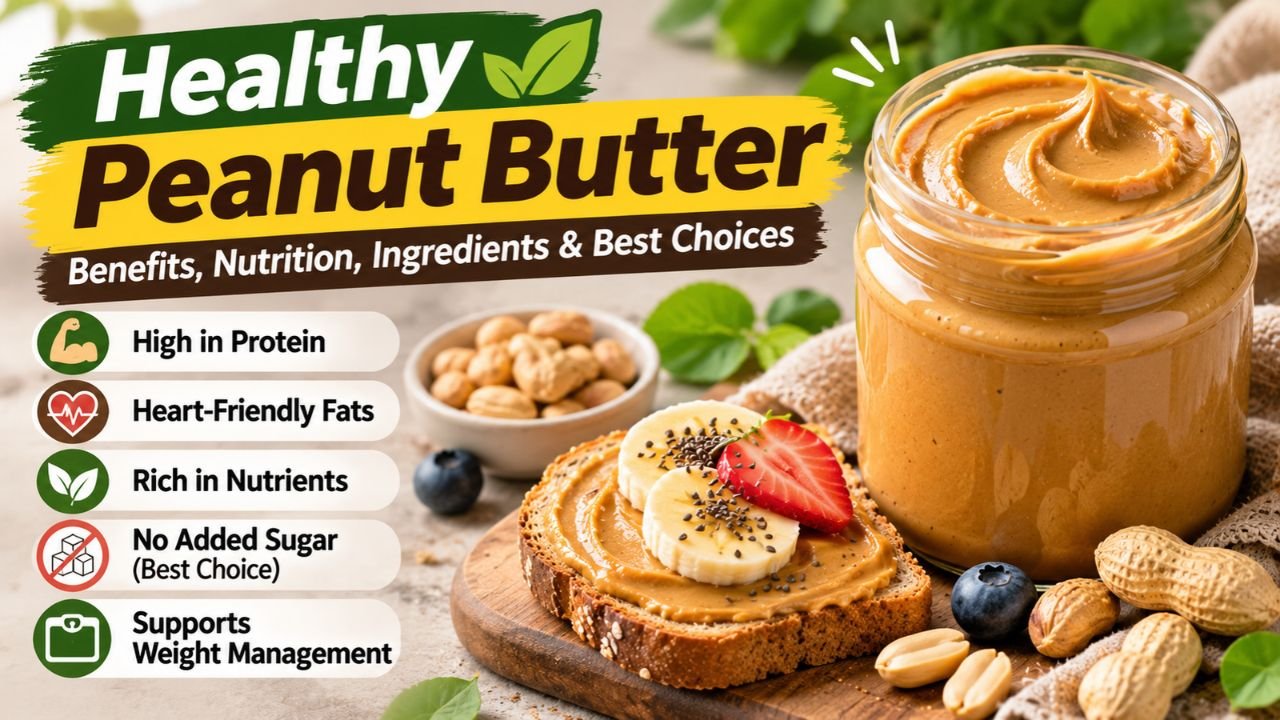
Healthy Peanut Butter: Benefits, Nutrition, Best Brands, and How to Choose the Best One
Peanut butter is one of the most widely used spreads among fitness buffs, athletes, and those seeking nutritional choices for their first meal of the day or as a snack. Its smooth consistency, delicious nutty taste and flexibility make it adaptable to many types of food. Peanut butter can be used with bread, bananas, apples, oatmeal, smoothies and numerous other homemade dishes.
However, all peanut butter products do not offer the same nutritional benefits. There are some types of peanut butter that include added sugar, excessive amounts of sodium, and other oils, which could be inconsistent with individuals’ dietary choices.
Including healthy peanut butters in your daily diet will allow you to consume protein, healthy fats, fiber, and necessary minerals on a regular basis. Generally speaking, natural peanut butters (which are produced using only roasted peanuts) are usually the best option for individuals who like to know exactly what is going into their food.
What Makes Peanut Butter Healthy?
A high quality peanut butter will use minimal, basic ingredients, offer nutritional value and not include excess amounts of added sugars, nor any other non-essential ingredients.
Ideally, the ingredients used in making the product will include roasted peanuts and perhaps a little bit of salt. Since natural peanut butter contains no artificial preservatives, it tends to separate while being stored. As a result, when you go to eat the product, you may need to stir it prior to eating.
| Feature | What to Look For |
| Main Ingredient | Roasted peanuts |
| Added Sugar | Zero or very low |
| Protein | Around 7-8 grams per 2 tablespoons |
| Healthy Fats | Naturally occurring unsaturated fats |
| Fibre | Naturally present |
| Sodium | Low or moderate |
| Artificial Ingredients | Avoid unnecessary additives |
Don’t rely just on the packaging of a product or its marketing to find what is inside. Always look at the ingredients list first.
Read Also: Sugar Cookie Recipe || Types of Cake
Nutritional Value of Healthy Peanut Butter
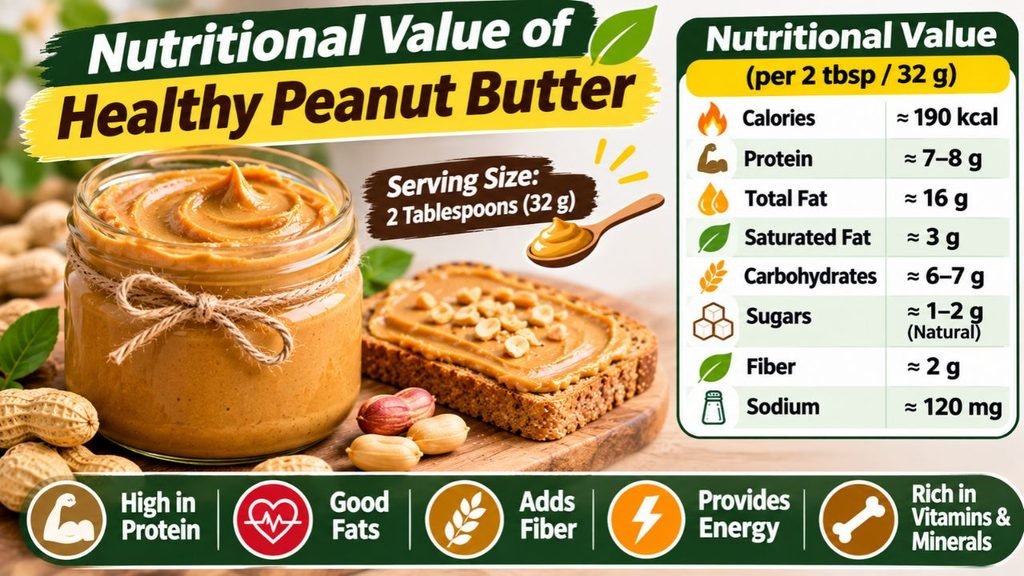
Peanut butter has a high amount of calories, however it also contains many key nutrients. The nutrient content for a standard serving size of 2 tablespoons (about 32 grams) includes:
| Nutrient | Approximate Amount |
| Calories | 185-200 kcal |
| Protein | 7-8 g |
| Total Fat | 16-17 g |
| Carbohydrates | 6-7 g |
| Dietary Fibre | 1.5-2 g |
| Sugar | 1-2 g |
| Magnesium | 50-55 mg |
| Potassium | 200-210 mg |
| Vitamin E | 2-3 mg |
The exact nutritional values depend on the product and its ingredients.
The protein in food is necessary for maintaining muscle mass. The unsaturated fat in food is an essential part of a healthy diet. The fiber in food is beneficial to digestion. Minerals like magnesium and potassium are needed by the body to function properly.
Top Benefits of Eating Healthy Peanut Butter
Adding some peanut butter to your everyday food intake has many nutritional advantages. Peanut Butter contains a mix of protein, fat, and other vitamins/minerals that can be used with various types of foods.
| Benefit | How It Helps |
| Muscle Support | Provides plant-based protein |
| Heart Health | Contains unsaturated fats |
| Better Satiety | Protein and fats help you feel full |
| Energy | Provides concentrated calories |
| Digestion | Contains dietary fibre |
| Nutrient Intake | Supplies magnesium and vitamin E |
Peanut butter may be especially beneficial to people who are always on-the-go, as it is both simple to incorporate into daily meals and fast to prepare. In addition to being used to enhance a variety of common food items, peanut butter should be utilized to supplement a well-balanced diet, not to substitute for other nutrient-rich foods.
Best Types of Healthy Peanut Butter
Depending on what ingredients you prefer, the consistency of the peanut butter you like, and your diet preference, there are different types of peanut butter. By being aware of your choices, you will be able to find the right product for you.
| Type | Description | Best For |
| Natural Peanut Butter | Mainly ground peanuts | Everyday consumption |
| Organic Peanut Butter | Made with certified organic ingredients | Organic food preferences |
| Unsweetened Peanut Butter | Contains no added sugar | Reduced-sugar diets |
| Crunchy Peanut Butter | Contains small peanut pieces | People who enjoy texture |
| Creamy Peanut Butter | Smooth consistency | Sandwiches and smoothies |
| Powdered Peanut Butter | Defatted peanut powder | Lower-fat recipes |
People who want to limit their intake of additives can usually begin by looking for natural and unsweetened varieties.
Best Healthy Peanut Butter Brands to Consider
There are many types of peanut butter available from several manufacturers that provide various types of peanut butter with different tastes, consistencies and costs. Consumers in India have access to a number of choices when shopping at supermarkets or online.
| Brand | Product to Explore | Key Feature |
| Pintola | All Natural Peanut Butter | Natural ingredient options |
| Alpino | Natural Peanut Butter | Creamy and crunchy varieties |
| MyFitness | Peanut Butter | Multiple flavour options |
| The Whole Truth | Peanut Butter | Simple ingredient-focused products |
| Sundrop | Peanut Butter | Widely available |
| DiSano | Natural Peanut Butter | Budget-friendly options |
| Happilo | Peanut Butter | Nut-based food products |
| Crazy Richard’s | 100% Peanuts | Simple peanut-only formulation |
Product formulation may be different even for products of the same brand. Check the ingredient list, sugar content, protein and sodium level of each product prior to purchase.
Natural vs Regular Peanut Butter: What’s the Difference?
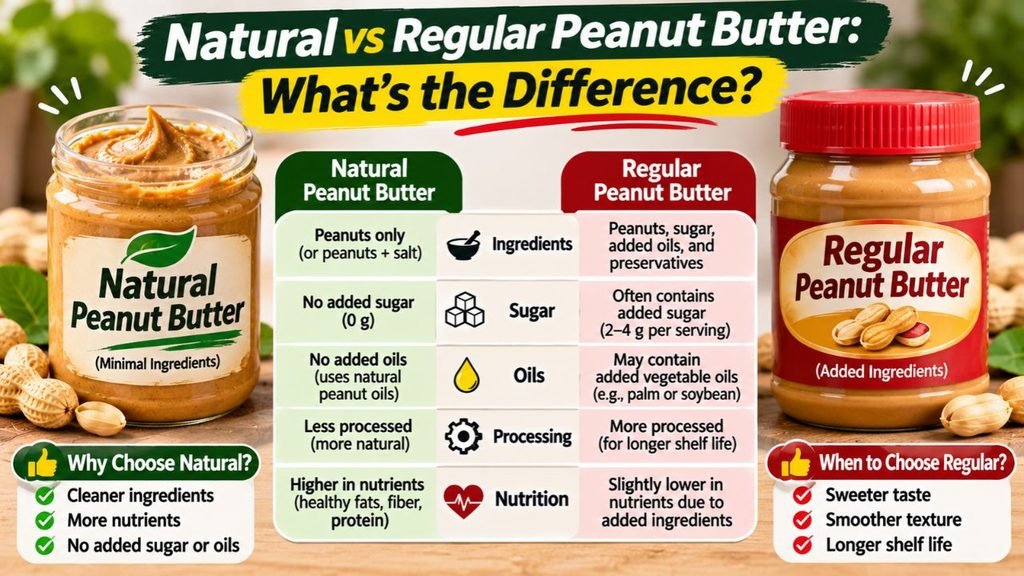
Peanut butter that is “natural” or “regular” might appear to be the same, however; they could have different ingredients as well as different manufacturing processes.
| Comparison | Natural Peanut Butter | Regular Peanut Butter |
| Ingredients | Mostly peanuts | Peanuts and additional ingredients |
| Added Sugar | Usually none | May contain added sugar |
| Oils | Natural peanut oil | May contain added oils |
| Texture | Can separate naturally | Often consistent |
| Processing | Usually simpler | Depends on the product |
| Nutrition | Depends on formulation | Depends on formulation |
Regular peanut butter can be an excellent option for nutritional benefits if it has been formulated correctly; however, natural peanut butter may be better if you prefer to use fewer ingredients.
Ingredients to Look for When Buying Healthy Peanut Butter
Check the label before buying a item. The simpler the ingredients, the easier they will be to assess.
- Roasted Peanuts: Ideally, peanuts should be the main or only ingredient.
- Natural Peanut Oil: Oil separation is normal in many natural varieties.
- Small amounts of salt can be added to your food. However, as with all other forms of seasoning, the use of salt should be kept to a minimum if you need to limit the intake of sodium.
- No Unnecessary Additives: Prefer products with simple formulations.
Don’t always think that products with a higher price tag will be better for your health. Look at both products’ nutrition labels and ingredient lists prior to choosing one.
Ingredients to Avoid in Peanut Butter
There are many other ingredients that can be added to some peanut butter products to enhance the product’s sweet taste, flavor, texture and/or shelf-life. Many times, these additional ingredients are not required.
| Ingredient | Why to Limit It |
| Added Sugar | Increases sugar consumption |
| Partially Hydrogenated Oils | Can contain unhealthy trans fats |
| Excessive Salt | Increases sodium intake |
| Artificial Flavours | May be unnecessary |
| Sweetened Chocolate Additions | Can increase calories and sugar |
A shorter ingredient list makes it easier for consumers to evaluate the product. However, when evaluating a product, always use the entire nutritional label rather than just using one ingredient to judge the product.
How to Choose the Best Healthy Peanut Butter
When you take into account some of the most critical aspects of choosing a product, finding the correct one will be simpler. First, check to see if peanut is listed as the main component in the list of ingredients.
Choose foods that have minimal amounts of added sugars and find out how much protein each of those foods has. To help you control your sodium intake, select a low sodium version.
In addition to these features, you may want to take into account how the product feels on your tongue, what it tastes like, how much it costs and whether or not you can get it. There are some individuals who would rather have a smooth and creamy peanut butter for their smoothies; other people like the crunchiness of certain types of peanut butter when they put them on their bread.
When shopping, comparing prices based on weight (e.g., price per 100g) allows you to select a product that is within your price range and has high-quality ingredients.
How Much Peanut Butter Should You Eat Per Day?
Peanut butter can be a part of most healthy diets, however you should pay attention to how much you eat, as peanut butter contains a lot of calories.
| Serving Size | Approximate Calories |
| 1 Teaspoon (5 g) | 30 kcal |
| 1 Tablespoon (16 g) | 95 kcal |
| 2 Tablespoons (32 g) | 190 kcal |
| 3 Tablespoons (48 g) | 285 kcal |
Many adults will find that 1-2 tablespoons is an appropriate serving size for them, based upon the number of calories they require, as well as the nature of their entire daily diet.
To help you maintain a healthy weight, measuring how much food you eat will assist in preventing too many calories from being consumed.
Healthy Ways to Include Peanut Butter in Your Daily Diet
You can easily include peanut butter in your diet through some of the most basic ways. For example, you may choose to include it in your breakfast meal, your snack at mid-day, or even in your own homemade dessert.
| Food Combination | Preparation |
| Whole-Wheat Bread | Spread peanut butter over toasted bread |
| Banana | Add peanut butter to banana slices |
| Oatmeal | Mix a spoonful into cooked oats |
| Smoothies | Blend with milk and banana |
| Apples | Use peanut butter as a fruit dip |
| Greek Yogurt | Mix into plain yoghurt |
| Energy Bites | Combine with oats and seeds |
These combinations provide different nutrients and make everyday meals more interesting.
Is Healthy Peanut Butter Good for Weight Loss?
A portion of peanut butter, if eaten in moderation, may be part of a weight loss program. The peanut butter has protein and fat which will allow you to feel full after you eat.
The problem with it being calorie-dense, is that if you consume too much of it, you could be increasing your overall calorie consumption each day. Therefore, making managing your weight a lot harder.
To create a healthy snack option that is well rounded, combine 1 tablespoon of unsweetened peanut butter with either a whole apple or a slice of whole wheat bread. Ultimately, weight loss is dependent upon your overall nutritional intake, exercise routine, and total number of calories consumed.
Possible Side Effects and Who Should Avoid Peanut Butter
Even though peanut butter provides many health benefits, there are certain individuals who will experience adverse effects from consuming too much peanut butter.
| Possible Concern | Explanation |
| Weight Gain | Large portions increase calorie intake |
| Digestive Discomfort | Some people may experience bloating |
| Allergic Reactions | Peanuts are a common food allergen |
| Excess Sodium | Salted products may contain considerable sodium |
| Added Sugar | Sweetened products increase sugar intake |
People with peanut allergies should avoid peanut butter because allergic reactions can be serious.
Individuals monitoring their calorie or sodium intake should choose appropriate products and serving sizes. Anyone with specific medical or dietary restrictions should consult a qualified healthcare professional.
FAQ About Healthy Peanut Butter
1.Which is the healthiest peanut butter?
Natural peanut butter made primarily from roasted peanuts without added sugar or partially hydrogenated oils is generally a good choice.
2. Is peanut butter healthy for everyday consumption?
Yes, moderate portions can fit into a balanced diet for most people who do not have peanut allergies.
3. Does peanut butter help with weight loss?
It may help you feel full because it contains protein and fats. However, portion control is important due to its calorie content.
4. Which peanut butter is best for gym beginners?
Unsweetened natural peanut butter is a practical option. Combine it with other protein sources to support muscle development.
5. How much protein does peanut butter contain?
Two tablespoons generally provide around 7-8 grams of protein.
6. Is crunchy or creamy peanut butter healthier?
Both can offer similar nutritional benefits when their ingredients are comparable.
Final Thoughts
Understanding what goes into making natural peanut butter will help make it simpler for you to choose a healthy option. When you are looking for a healthy alternative, you want to be sure that your peanut butter provides you with protein, unsaturated fat, fiber, and some of the most important minerals that your body needs each day.
Compare various brands, check the nutritional values on the label, and then choose products that meet both your dietary needs and what you can afford. This healthy spread can be used in many ways such as on toast, bananas, oatmeal, or even added to smoothies; however, if you are going to use it at all, you must do so in moderation to get the most benefits.
Also Read: Best Subway Sandwich | Japanese Beer | Best Instant Coffee