
Best Coffee Beans for Espresso: 14 Options for a Rich and Flavorful Cup
Choosing the right coffee beans for espresso can have a significant impact on the taste, smell, crema and quality of your coffee. Espresso is a very concentrated brew method, so the beans you decide on have an elastic result at the final cup.
Unlike traditional brewed coffees, espresso extracts flavor in a short amount of time and under pressure. This is to say that the right roast level, freshness, grind size, origin and blend can all determine the outcome.
Whether you prefer a boldly flavored traditional espresso, silky smooth latte, or rich creamy cappuccino, the right beans will lead to improved espresso machine results. Here are 14 coffee beans/profiles that you should consider.
What Makes the Best Coffee Beans for Espresso?
The best espresso roast is not the same for everyone. While this is all a matter of personal preference, there are a few characteristics that make certain beans more suitable for espresso brewing.
There are many things that will come into consideration, such as freshly roasted whole beans, the right roast level, balanced acidity but not too much body, and flavours that you enjoy and work well at pressure.
Java fans’ warm and deep flavor is rich in dark roast, while some use their wares to produce fruity and floral notes. Which means, no one bean is the absolute best for every espresso drinker out there.
14 Best Coffee Beans for Espresso
1. Italian-Style Espresso Beans
Italian espresso beans are a favorite choice for espresso lovers. Usually, they are a fuller-bodied coffee with strong roasted character with flavors such as chocolate, caramel and nuts.
This bean is rounder suited to traditional espresso shots and milk-based drinks. Even when it is combined with milk, they have a more pronounced taste.
2. Medium Roast Coffee Beans
At the middle ranges of roast, both acidity, sweetness but also body are present in a balance differentiated by other roasts. It allows them to retain more of the coffee’s natural traits whilst still being able to make an espresso that is not flimsy.
Medium roasts can produce caramel, chocolate, fruit or nutty notes depending on the origin. They are a great choice for someone who wants to try out different espresso profiles.
3. Medium-Dark Roast Coffee Beans
Medium-dark roast beans offer deeper and bolder flavors than medium roasts. They often give off notes of dark chocolate, caramel, roasted nuts and spices.
This roast is particularly effective while you make cappuccinos, lattes and flat whites because the stronger taste can stand up to other dairy.
4. Dark Roast Coffee Beans
Dark roast coffee beans have strong and powerful characteristics. They generally exhibit lower perceived acidity, and can give way to smoky, bittersweet roasted or dark chocolate flavors.
Dark roast beans can be well suited if you like to drink a more powerful traditional espresso with a heavier body. They are also quite common for espresso drinks with milk in them.
5. Arabica Coffee Beans
Arabica beans are known for their smoothness and variety of tastes. They range from chocolate, fruit, floral, caramel or nutty notes depending on where they are grown and how they are processed.
Arabica are better for espresso because they make a clean and fragrant cup. If you want a rich and sweeter flavor without being over-the-top strong, then they will work for you too.
6. Arabica-Robusta Blends
Arabica-Robusta blends mix the traits of both major coffee species. Arabica provides sweetness and aroma complexity, while Robusta gives body, intensity and crema.
Typically, these blends are tied to a historical espresso style. They can be ideal for those people who love a stout espresso with a big mouthfeel.
7. Single-Origin Coffee Beans
Single Origin – Single origin coffee beans originate from one producing region, country, or area. Their taste can vary according to growing conditions, altitude, species and processing method.
If you are interested in tasting a lot of different flavors, single-origin espresso is an interesting option. They can range from fruity and bright to rich, sweet, or chocolatey.
8. Brazilian Coffee Beans
Brazilian coffee beans typically come to mind as sweet, nutty, chocolaty, and balanced. These traits can translate great in espresso as it gives a much comfier and more inviting cup.
Other beans from Brazil are good for milk drinks. Their sweet and nutty flavor can sometimes pair nicely with the creaminess of milk.
9. Colombian Coffee Beans
Colombian coffee is known for its balanced character and pleasant acidity as well. Colombian coffee notes can be caramel, chocolate, fruit or even nutty; depending on the specific coffee you are brewing an espresso from.
These beans can suit drinkers looking for an espresso that is bright yet complex. With that, they are also adaptable for various brewing methods.
10. Ethiopian Coffee Beans
Tips: You can get an espresso that you normally wouldn039;t find somewhere like Ethiopian coffee beans. They have flavors often described as fruity, floral, citrus, and berry-like.
For those who enjoy Italian-style espresso with a modern, aromatic twist the Ethiopian beans can be a good option as well. They tend to be more flavourful than traditional dark roasted espresso blends.
11. Chocolate and Nutty Espresso Beans
Chocolate and nutty flavor profiles are popular for most espresso drinkers. These beans can yield taste notes of cocoa, almonds, hazelnuts, caramel or roasted nuts.
They will also taste great as a straight espresso, but they can take milk well, too! If you are not sure what to start with then this flavor profile should be a go for you.
12. Fruity and Floral Espresso Beans
These fruity and floral beans are the coffee drinkers who crave something other than dark, smoky espresso. Floral, citrusiness, stone-fruit, and berry qualities can all be seen depending on the coffee.
And, if they use these beans, they can yield a more lively espresso with a fuller flavor spectrum. They are particularly fascinating to any coffee lovers who want to taste the native variables of origins.
13. Freshly Roasted Whole Beans
One of the most important factors in choosing the best coffee beans for espresso is freshness. Coffee beans gradually lose aromatic compounds after roasting, which greatly affects flavor and aroma quality.
In general, whole beans are desired over pre-ground coffee due to the fact that grinding increases the surface area exposed to air. Therefore, grinding your beans right before brewing is an excellent way to lock in aroma and flavour.
14. Espresso Beans for Milk-Based Drinks
Ideally, cappuccinos, lattes, and flat whites should be made from beans that have strong flavors capable of standing up to the addition of milk. Chocolate, caramel, nutty and dark roasted profiles are usually a safe bet.
These drinks can incorporate some of the more biased espresso blends like medium-dark and traditional. Lighter and fruitier coffees on the other hand can make some unique combinations however if you are into that.
How to Choose the Best Coffee Beans for Espresso
Understanding the flavor you like is how to choose appropriate beans. For a punchy coffee experience, opt for a dark (or a medium-dark) roast.
Medium roasts might be a better starting point for sweeter, more balanced espresso experiences. If you like fruit or floral notes in your coffee, opt for a single-origin with a lighter roast profile.
Another factor to keep in mind is the roast date. Fresh beans can lead to a much better aroma and flavor than beans that have been sitting around for months.
Medium Roast vs. Dark Roast for Espresso
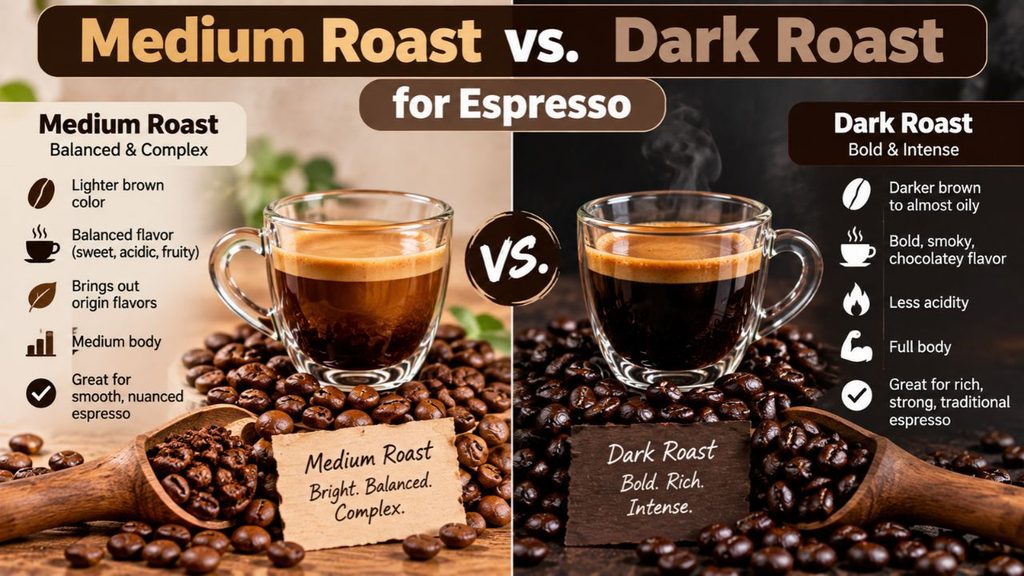
Both medium and dark roasts can work well in espresso, but they produce noticeably different results.
| Feature | Medium Roast | Dark Roast |
| Flavor | Balanced and complex | Bold and intense |
| Acidity | Usually more noticeable | Usually lower |
| Body | Medium to full | Full and heavy |
| Common Notes | Caramel, fruit, chocolate | Dark chocolate, smoke, roasted notes |
| Milk Drinks | Very good | Excellent |
| Straight Espresso | Complex | Strong and traditional |
The choice ultimately depends on your preferred taste rather than a universal rule.
Single-Origin vs. Espresso Blends
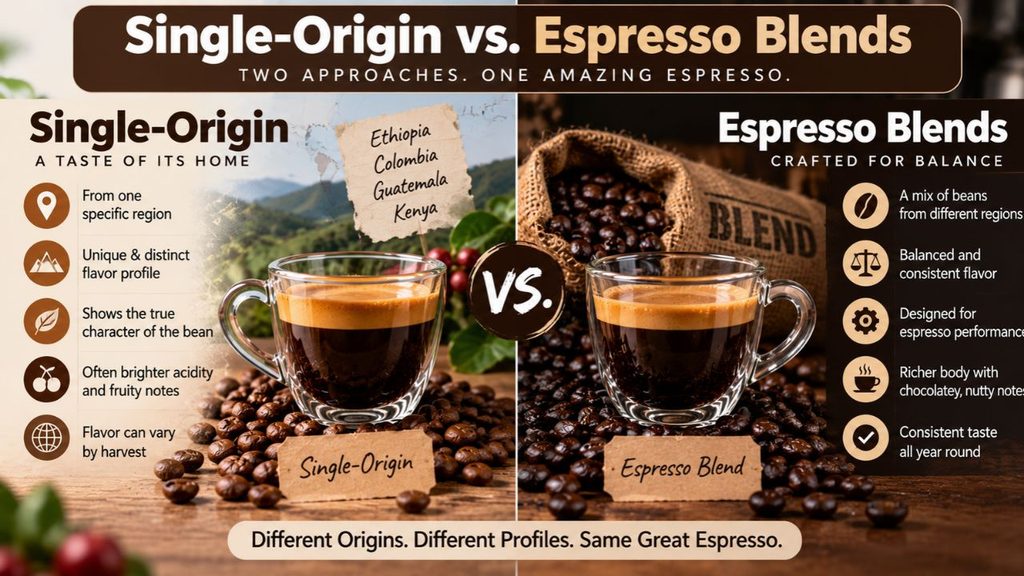
Single-origin coffee comes from a specific area, which allows you to taste special properties related to that area. Blends mix coffees together in order to achieve a specific balance of flavors.
Blends tend to be more consistent and are often created specifically for espresso. Single-origins are often much more unique in flavor and for when you want to taste a specific region where the coffee is produced.
Arabica vs. Robusta for Espresso
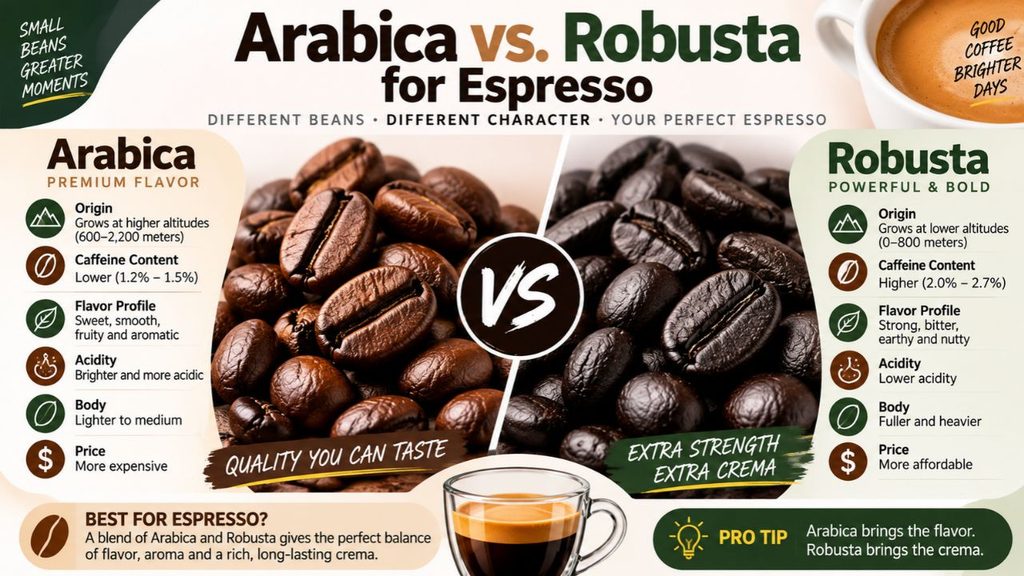
Arabica tends to have more flavor complexity and can be sweeter and more aromatic. Robusta can give a more intense bitter body and crema.
Neither is automatically the right choice for all. Someone who enjoys complex flavors would probably love an Arabica coffee, while someone craving a strong traditional espresso may prefer an Arabica-Robusta blend.
Why Freshness Matters
Aromatic compounds in freshly roasted coffee play a major role in flavor and aroma. Coffee will lose some of those good traits over time if it is exposed to oxygen.
So reading a roast date on espresso beans can often be more informative than an expiration date when buying. Keep beans in an airtight container away from heat and moisture and direct sunlight.
How to Grind Coffee Beans for Espresso
A fine and uniform grind is what espresso usually calls for. Grind size determines how fast water moves through the coffee during extraction.
The results are that the water will flow too fast if it is too coarse and a weak or even under-extracted shot may be produced. Extraction will take far too long, and an overly bitter cup if it is as fine as powdered sugar.
High quality burr grinder will give a more even grind then most entry level blade grinders.
How to Store Espresso Beans
Coffee is a delicate commodity, and they also work with proper storage. Store Whole Beans in an Airtight Container – In a cool, dry place away from direct sunlight.
Do not keep opening it unnecessarily because exposing it to the air makes it lose its freshness faster. Purchasing smaller amounts that can be used fairly soon is another way to go about keeping quality where it should be.
Common Mistakes When Choosing Espresso Beans
A common mistake is to choose coffee only based on roast. This does not mean that darker roasts automatically produce superior espressos (or that lighter roasts cannot be the best!), and in fact it is relatively rare to find a world class espresso brewed from a dark roast coffee.
Yet another mistake is to acquire large quantities without regard for freshness. In addition, coffee that sits untouched for a prolonged period of time may lose some of its aroma and flavor.
Another common mistake is to use an inappropriate grind size. Even decent coffee beans can yield bad espresso if the grind, dose or extraction settings are incorrect.
How to Get Better Results From Espresso Beans
Use freshly roasted whole beans and grind right before you brew. Ensure your grinder is producing an even fine grind for your espresso machine.
Use a static coffee dose and observe extraction time weight of produced espresso. Changes to the grind can change everything.
Sour or thin espresso – If your espresso is tasting sour or has a watery mouthfeel consider grinding finer or adjusting your extraction settings. In fact, it you get a cup that tastes too bitter or harsh, changing the grind and for how long coffee is extracted will result in a much better taste.
Best Coffee Beans for Espresso: Quick Buying Guide
| Preference | Bean Type to Consider |
| Traditional strong espresso | Italian-style or dark roast |
| Smooth espresso | Medium roast Arabica |
| Rich body | Arabica-Robusta blend |
| Chocolate flavor | Brazilian or chocolate-profile beans |
| Fruity flavor | Ethiopian or other fruity single-origin beans |
| Nutty flavor | Brazilian or nutty-profile beans |
| Cappuccino | Medium-dark or traditional blend |
| Latte | Chocolate and caramel profile |
| Straight espresso | Medium or medium-dark roast |
| Experimenting with flavors | Single-origin beans |
FAQ
1. What are the best coffee beans for espresso?
The best coffee beans for espresso depend on your preferred flavor. Medium, medium-dark, dark, single-origin, and Arabica-Robusta beans can all produce excellent espresso when properly roasted, ground, and extracted.
2. Is Arabica or Robusta better for espresso?
Arabica generally provides more complex and aromatic flavors, while Robusta can provide stronger body, bitterness, and crema. Blends of the two can combine these characteristics.
3. What roast is best for espresso?
There is no single roast level that suits everyone. Medium roasts can provide balanced and complex flavors, while medium-dark and dark roasts often produce stronger, heavier espresso.
4. Can any coffee bean be used for espresso?
Most roasted coffee beans can technically be brewed using an espresso machine. However, beans with a flavor profile and roast level suited to espresso can make it easier to achieve a balanced and enjoyable shot.
5. Should espresso beans be ground immediately before brewing?
Yes. Grinding immediately before brewing can help preserve the coffee’s aroma and flavor. A consistent fine grind is generally needed for espresso extraction.
Final Thoughts
Selecting the right coffee beans for espresso is all about matching the brew to you. Classic dark roasts will give you the bold, aggressive flavor while medium or third wave roasts can provide a greater balance and complexity.
Arabica-Robusta blends are more capable of body and crema, whilst single-origin coffees bring in classic fruity, floral, chocolatey or nutty notes. But, freshness, the grind of your coffee, how you store it and your brewing technique matter just as much.
The only way to find out what works best for you espresso machine and coffee drinks is to play around with the roast profile, origin, and blend until one resounds in flavor.
Also Read: Olive Garden Menu With Prices | The Cheesecake Factory Menu With Prices
Starbucks Decaf Drinks | Cousins Maine Lobster Truck Menu With Prices